## Motivation {.center}
Democratic governments increasingly intervene in major online platforms -- sometimes shutting them down entirely.
- Ukraine blocked VKontakte to curb Russian propaganda (2017)
- India and Nepal have blocked TikTok and other platforms during political turmoil
- The US forced a sale of TikTok
- **Brazil banned X nationwide for 39 days (Aug 30 -- Oct 8, 2024)**
##
We know a lot about information control under authoritarianism (Roberts 2018; Pan and Siegel 2020; Boxell and Steinert-Threlkeld 2022) -- but almost nothing about bans and escalation of platform government policies in democracies
- Golovchenko (JoP, 2022) study on VKontakte block in Ukraine is main exception:
- Ban as a consequence of foreign intervention in Ukraine
- Dectect no partisan cleavage on who complies with th eBan
## {.center}
::: {.center .larger-font}
How do [partisan dynamics]{.red} shape compliance with platform bans ---
and what are the consequences for the [information environment]{.blue} in a polarized democracy?
:::
# Context: The X Ban in Brazil {background-color="#23395b"}
## The ban followed a year-long escalation between Brazil's Supreme Court and X
- After Bolsonaro's 2022 defeat, right-leaning supporters contested the results -- truck lockouts, encampments, and a strong digital campaign on social media
- **January 8, 2023:** Bolsonaro supporters stormed Congress, the Supreme Court, and the presidential palace
- Supreme Court opened judicial inquiries, requested removal of accounts spreading misinformation. Meta and Google complied. **X refused.**
- **August 2024:** X's legal representative in Brazil resigned; leadership refused to name a replacement
- **August 30:** Supreme Court ordered a nationwide ban on X -- affecting ~40 million users
- **October 8:** Ban lifted after X complied with court demands (~39 days total)
## The sorting ratchet: a theory of partisan platform segmentation {.center}
When platform governance gets **politicized**, partisans face different incentives to exit or circumvent it. Exit or Circumvention depends on two distinct types incentives:
- **Reputational incentives:** Complying signals respect for institutional authority; circumventing signals defiance and partisan loyalty
- **Informational incentives:** If your co-partisans leave, the remaining content becomes less useful, lowering the payoff to staying
##
In Brazil, conservatives opposed the Supreme Court's ban. Liberals were more sympathetic.
::: {.fragment}
- **Asymmetric incentives:**
- **Right-leaning users** had strong reasons to circumvent: defiance, maintaining voice, keeping their audience
- **Left-leaning users** had reasons to comply: normative alignment with the court, alternative platforms (Bluesky), shrinking co-partisan audience on X
:::
::: {.fragment}
**Ratchet effect:** Co-partisans make similar exit/stay decisions, the platform sorts along partisan lines, and **the effect doesn't fully reverse** even after the ban lifts. Particularly true as digital space becomes more fragmented with more platforms
:::
# Data & Design {background-color="#23395b"}
## Pre-ban data: 14M tweets via the X Decahose to estimate ideology {.center}
**Source:** X Decahose API --- a 10% real-time sample of all public tweets
- 90 days before the ban (June -- August 2024)
- Filtered to Portuguese-language tweets containing a URL
- **~14 million tweets** total
- Feeds the user × news-domain matrix used for ideology recovery
- [The Decahose was retired shortly after collection --- this dataset is no longer reproducible.]{.midgray}
## Panel data: 7,471 politically engaged users tracked across 7 months {.center}
**Source:** Full timelines scraped via public *Nitter* instances (Decahose access was lost mid-project)
- **Sample frame:** users from the pre-ban data who shared ≥5 distinct political news domains → 9,061 candidates
- **Successfully collected: 7,471 of 9,061** (~18% attrition: account deletion, handle changes, suspension, private settings)
- **Window:** June 1 -- December 31, 2024
- **~6.7M tweets**, **~430K political news shares**
- Non-random sample, but a small share of users generates most political content on the platform (Grinberg et al. 2019; Baribi-Bartov et al. 2024).
## Correspondence Analysis recovers ideology from news-sharing behavior {.center}
$$
\underbrace{\begin{array}{c|cccccc}
& \text{folha} & \text{globo} & \text{jovempan} & \text{oeste} & \cdots \\
\hline
\text{user}_1 & 12 & 8 & 0 & 0 & \cdots \\
\text{user}_2 & 0 & 1 & 15 & 9 & \cdots \\
\text{user}_3 & 7 & 11 & 2 & 0 & \cdots \\
\vdots & \vdots & \vdots & \vdots & \vdots & \ddots
\end{array}}_{\textbf{9{,}061 users}\;\times\;\textbf{242 domains}}
$$
[Each cell = number of times user $i$ shared a link from domain $j$. CA decomposes this matrix; the first dimension orders users and domains from left to right --- *user*$_1$ looks left-leaning, *user*$_2$ right-leaning.]{.midgray}
## Processing and Estimation
:::fragment
**Filtering**
- Domains: >100 total shares, shared by >10 distinct users
- Users: shared >5 distinct political news domains
- **Intuition:** Capture politics as a core dimension of this non-random sample
:::
::: fragment
**Estimation**
- Correspondence Analysis on the user × domain matrix
- First CA dimension = ideological position for users *and* domains
- **Intuition:** Users sharing similar outlets cluster together; left and right separate cleanly
:::
# Results: Validation {background-color="#23395b"}
## Ideology scores have strong face validity {.center}
{fig-align="center" width="85%"}
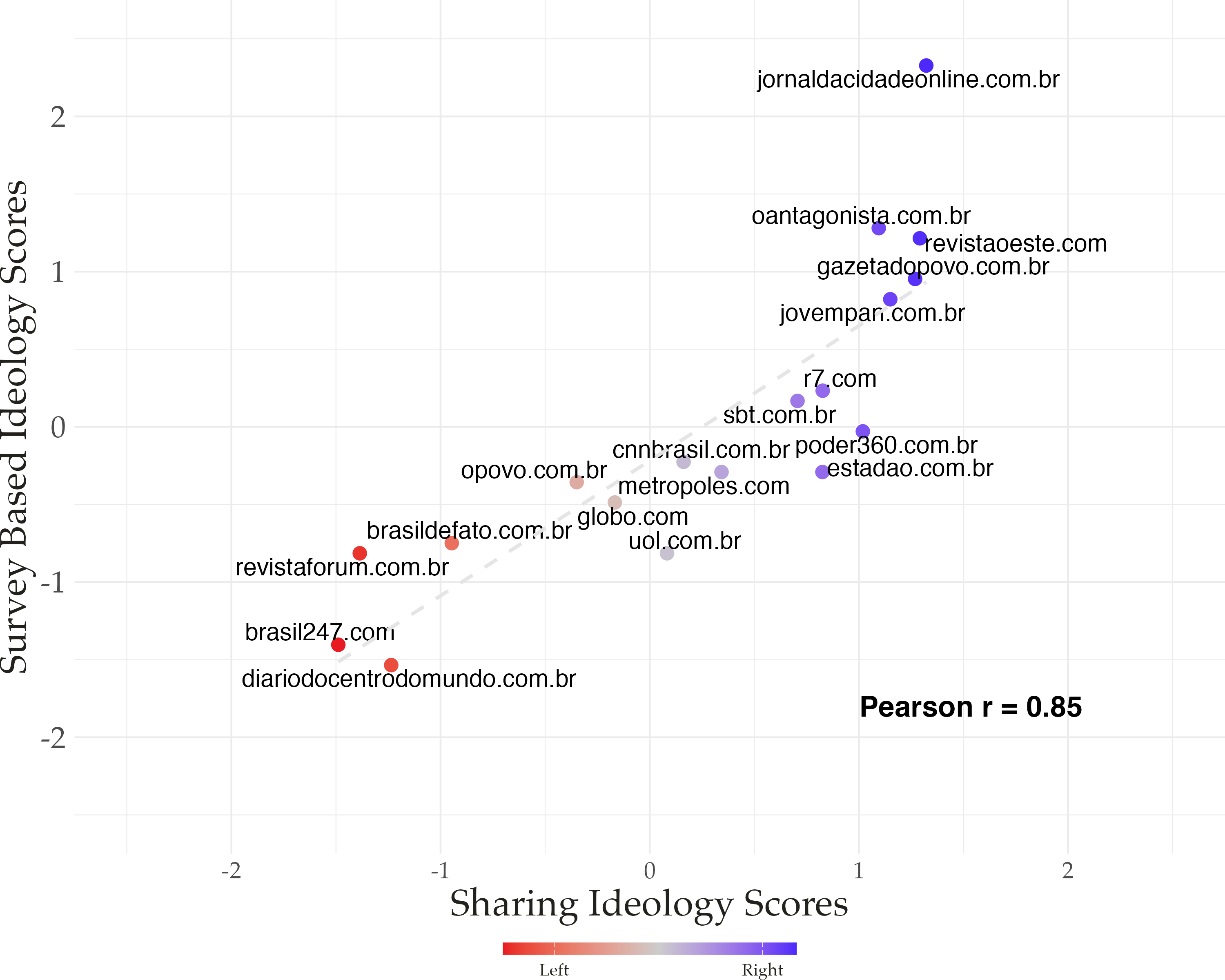
## Behavioral scores correlate at r = 0.85 with survey-based measures {.center}
{fig-align="center" width="65%"}
::: aside
[Survey-based ideology from Mont'Alverne et al. (2024), matched on 24 organizations]{.midgray}
:::
# Results: General Effects of the Ban {background-color="#23395b"}
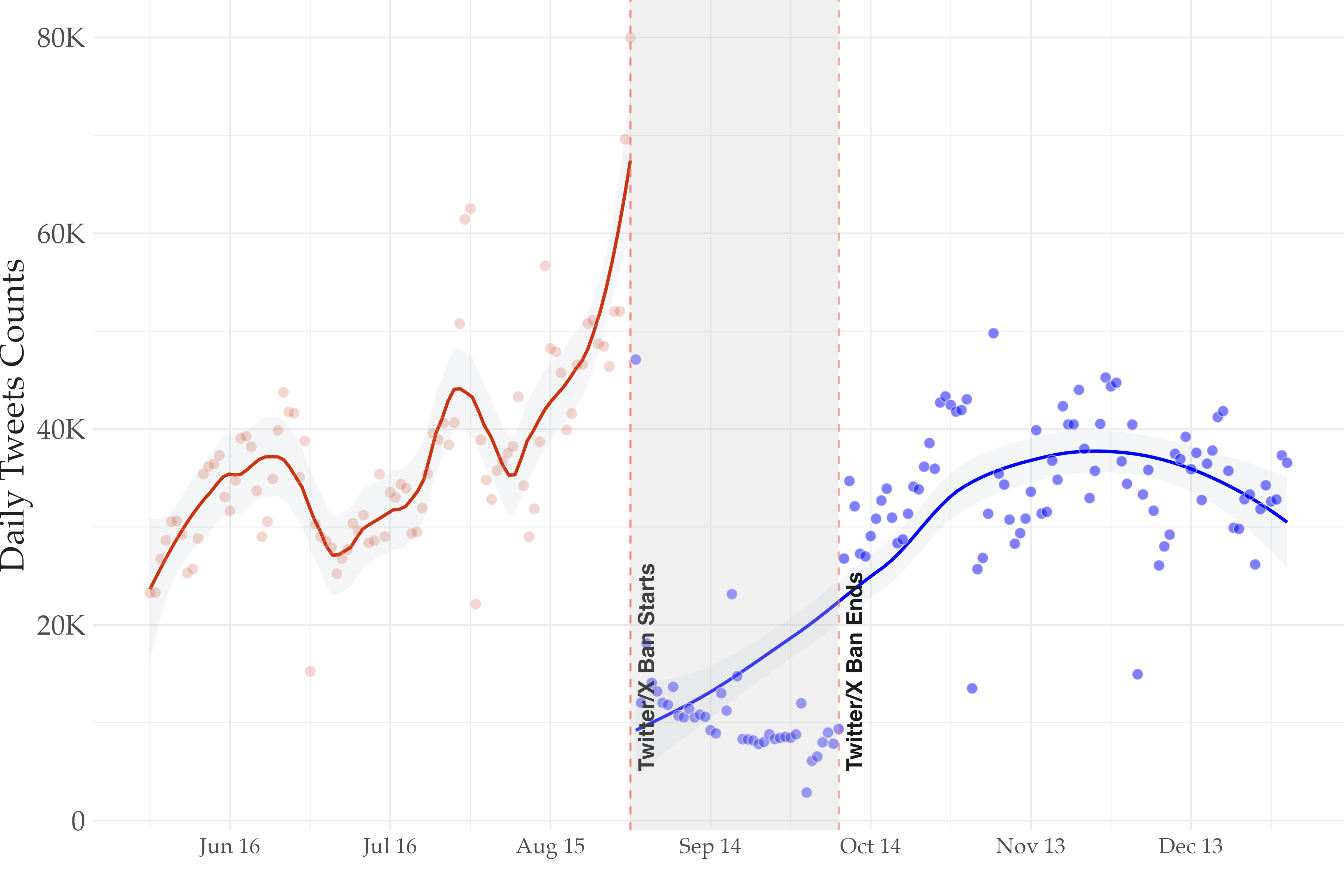
## The ban cut posting and news sharing sharply -- but not to zero {.center}
{fig-align="center" width="85%"}
::: aside
[Daily averages dropped from 37,207 tweets to 11,305 during the ban. News sharing fell from 2,587 to 395 per day.]{.midgray}
:::
## News sharing followed the same pattern {.center}
{fig-align="center" width="85%"}
## Results: Partisan Effects of the Ban
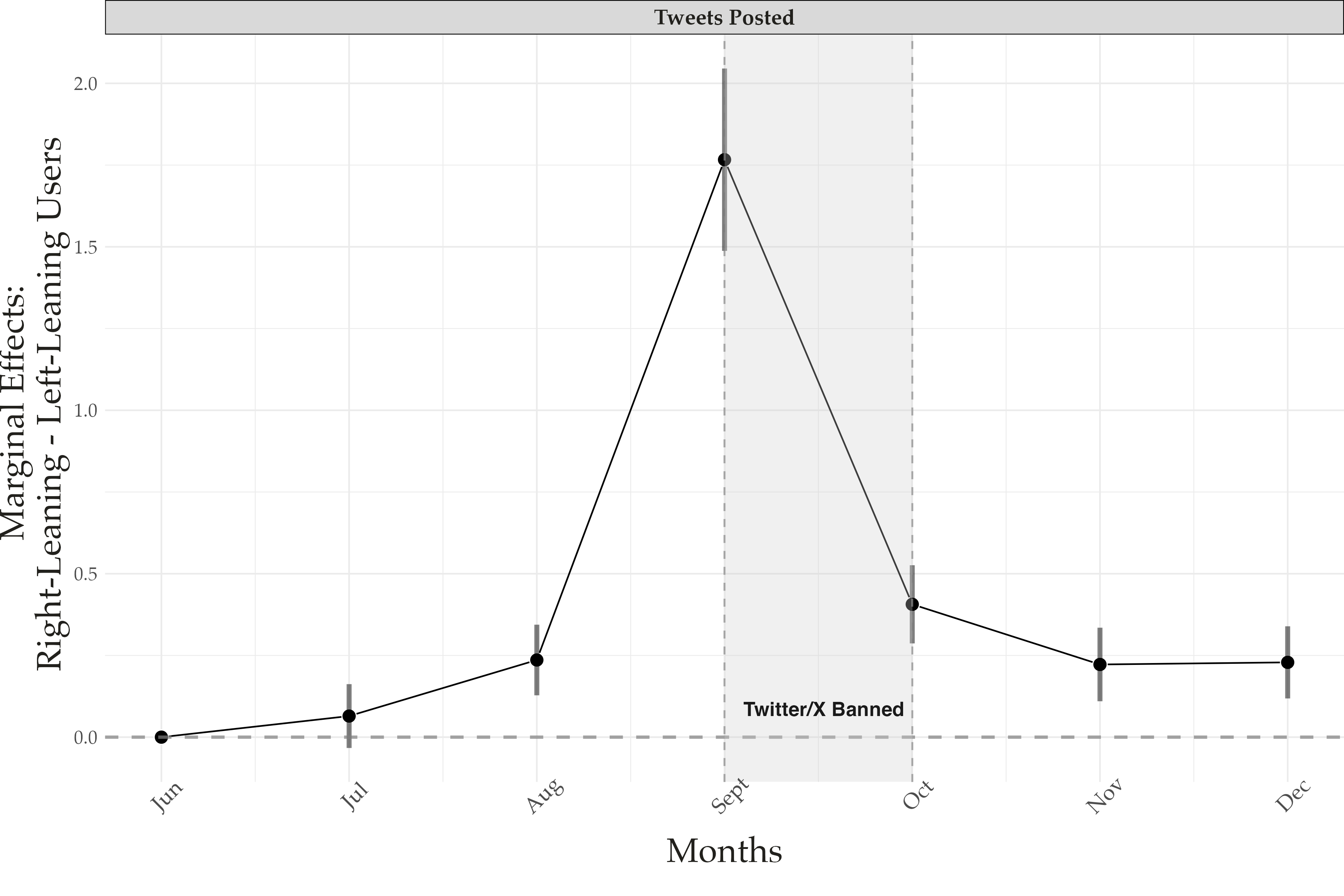
We identify the causal effects of the ban using a Poisson event-study model:
$$y_{ij} \sim \text{Poisson}(\lambda_{ij})$$
$$\lambda_{ij} = \exp\left(\alpha_i + \tau_j + \sum_{t=1}^{6} \beta_t \cdot \text{Right-leaning}_i \cdot \text{Month}_t\right)$$
::: {.fragment}
Where:
- $y_{ij}$ - Count of tweets by user $i$ on day $j$
- $\alpha_i$ - User fixed effects (absorbs baseline activity differences)
- $\tau_j$ - Day fixed effects (absorbs platform-wide shocks)
- $\text{Right-leaning}_i$ - Binary: ideology score > 0
- $\text{Month}_t$ - Monthly indicators (June = baseline)
- $\beta_t$ - **Parameters of interest:** how much more active right-leaning users are in month $t$ relative to left-leaning users
:::
## Right-leaning users were 5.8x more active during the ban {.center}
{fig-align="center" width="85%"}
::: aside
[Poisson event-study: right-leaning users' posting rate increased 5.8x relative to left-leaning users during the ban (exp(1.76), z = 12.6). Effects persist at smaller magnitude post-ban.]{.midgray}
:::
## Right-leaning news domains dominated sharing during the ban {.center}
{fig-align="center" width="85%"}
::: aside
[Similar partisan sorting at the domain level. Less precise due to smaller N, but the direction is clear.]{.midgray}
:::
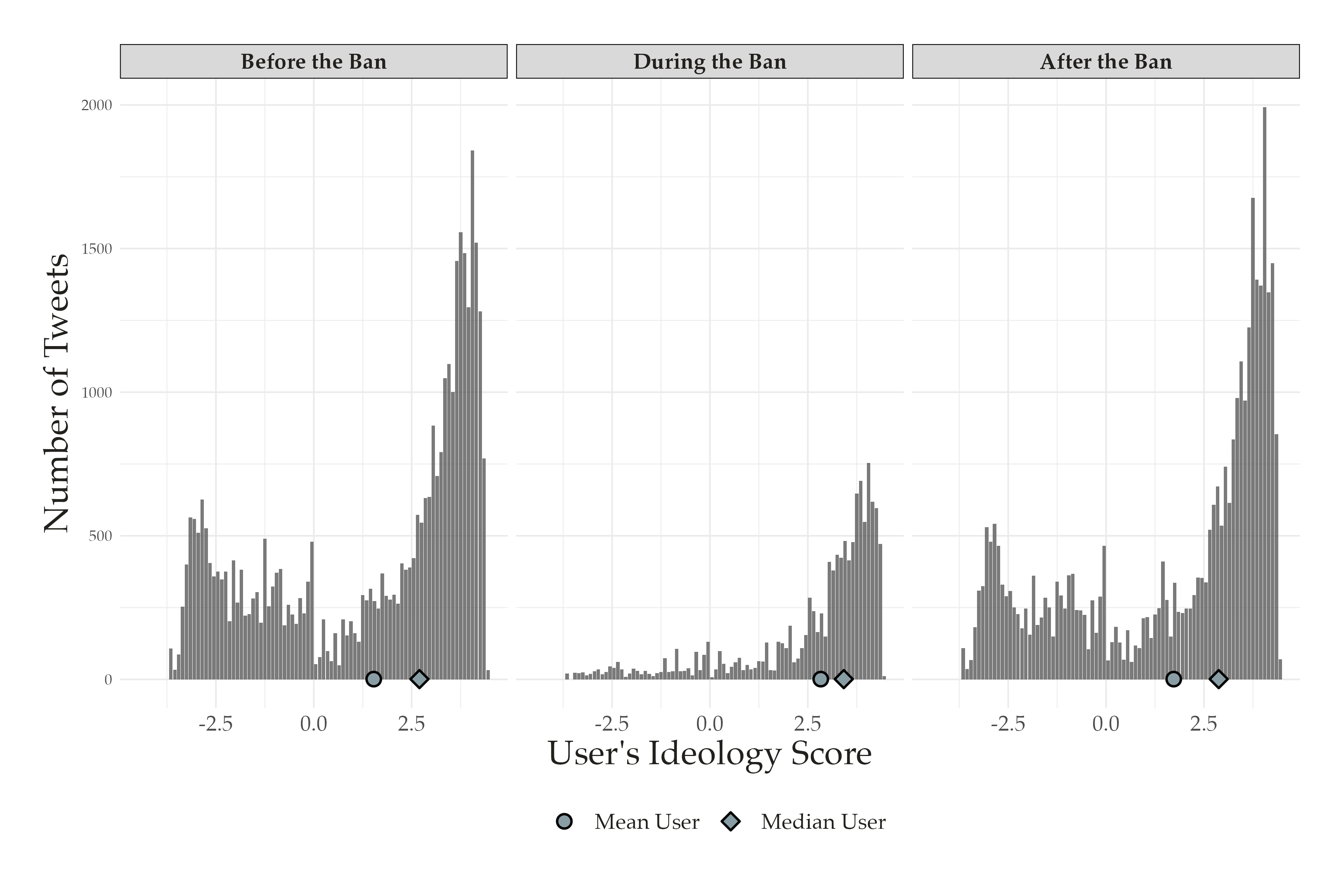
## Right-leaning users produced the vast majority of content during and after the ban {.center}
{fig-align="center" width="80%"}
::: aside
[Centrist and left-leaning users largely went silent during the ban, while right-leaning users continued producing most of the platform's content.]{.midgray}
:::
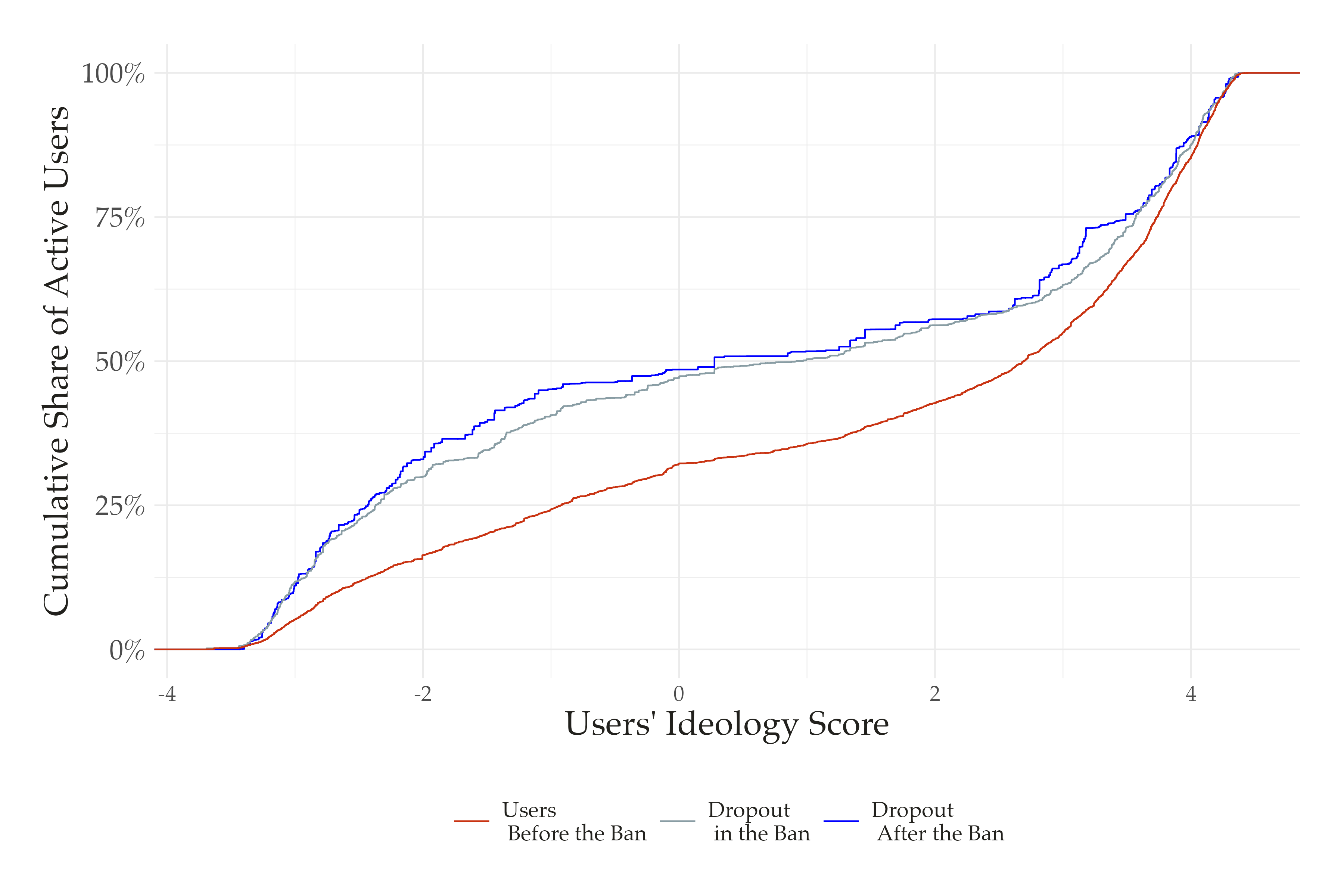
## 9% of politically engaged users never returned to X {.center}
{fig-align="center" width="80%"}
::: aside
[Of 7,291 pre-ban users, 2,346 went silent during the ban and 656 never came back. Dropout was disproportionately left-leaning -- the share of right-leaning users among dropouts fell from 70% to 50%.]{.midgray}
:::
# Results: Downstream Effects{.center}
## The news environment shifted 1.05 SD to the right during the ban {.center}
{fig-align="center" width="80%"}
::: aside
[Median domain ideology: 0.27 before, 1.26 during, 0.30 after the ban. During the ban, the information environment was equivalent to content from right-wing extremist portals.]{.midgray}
:::
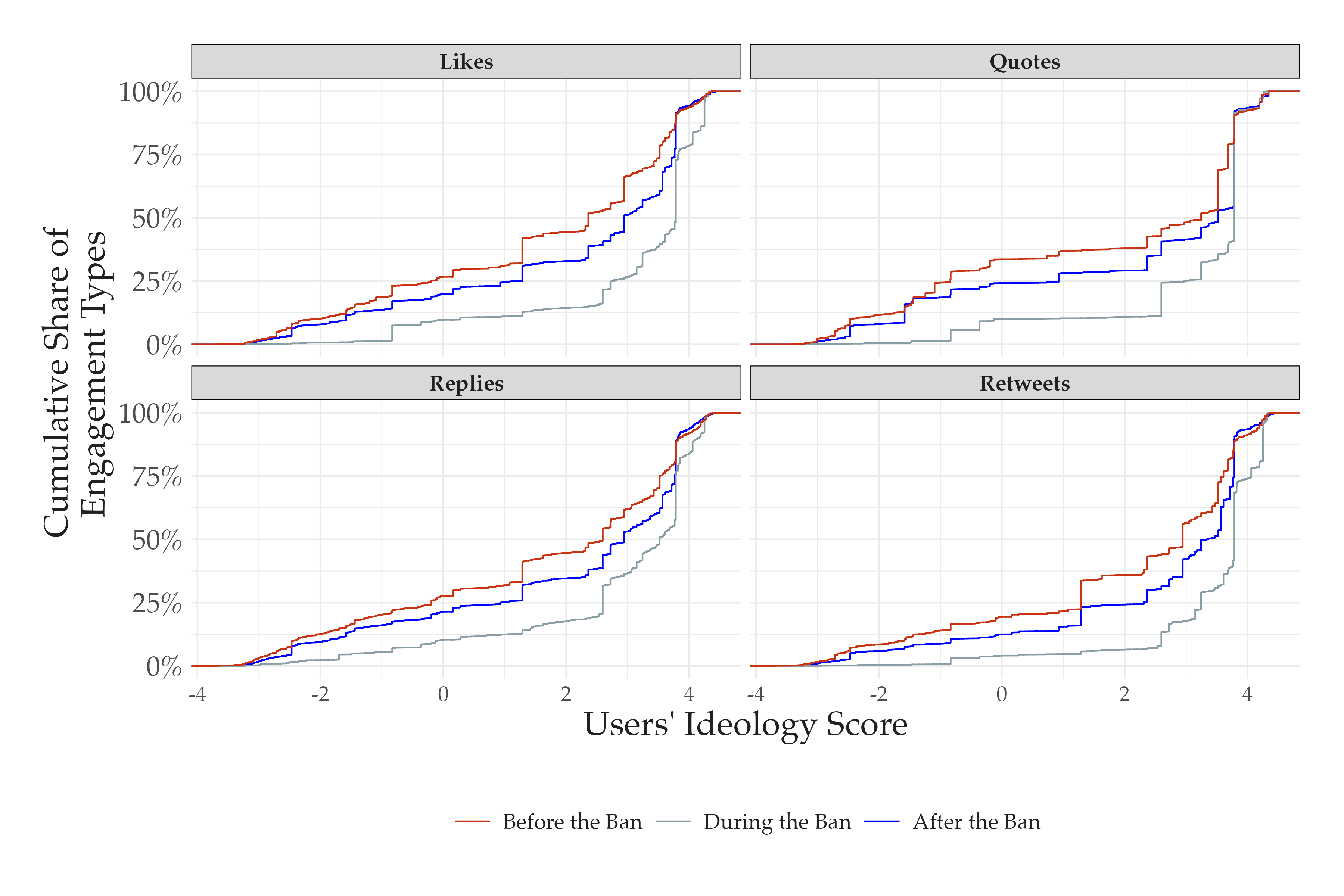
## Engagement became concentrated among right-leaning users -- and stayed that way {.center}
{fig-align="center" width="80%"}
::: aside
[Right-leaning users received 73% of likes pre-ban, 90% during, and 80% after. Similar patterns for retweets, quotes, and replies.]{.midgray}
:::
## Sorting Ratchet: Asymmetric compliance + selective dropout = lasting partisan segmentation {.center}
::: {.nonincremental}
1. **The ban is politicized:** Right-leaning users opposed the court decision. Left-leaning users supported it.
2. **Compliance diverges:** Conservatives circumvent; progressives comply or exit to alternatives (e.g., Bluesky).
3. **The platform tilts right:** Content, news, and engagement all shift toward conservative users.
4. **The ratchet locks in:** Even after the ban lifts, habits and networks have changed. Left-leaning users don't fully return. The rightward shift persists.
:::
## Implications
1. Conflicts over platform regulation in **polarized democracies** can generate durable partisan shifts in participation
2. **These changes are sticky.** Three months after the ban lifted, X was still more conservative. 9% of users never came back.
3. **The so-called Echo Chambers** are not anymore a space in the platform user graph, but the platform entirely
4. **Policy Trade-off:** Measures to curb misinformation may produce unintended downstream effects in the digital ecosystem.
## Limitations and next steps {.center}
::: {.nonincremental}
- Sample of politically engaged users -- effects on casual users may differ
- Platform-specific: we can't observe spillovers to Bluesky, Threads, or other alternatives
- Scope condition: the Brazilian context (polarization, judicial politics) shapes these dynamics, polarization + platform fragmentation
- Future work: cross-platform migration data, comparative cases, elite vs. mass behavior
:::
## {background-color="#23395b"}
::: {.center .larger-font}
Thank you
:::
[tiago.ventura@georgetown.edu]{style="color: white; font-size: 0.8em;"}